
Growth is one of the most important concepts in language, business, economics, education, biology, and personal development. It generally refers to progress, expansion, improvement, or an increase in size, value, knowledge, or capability. However, understanding the opposite of growth is equally important because many situations involve decline, stagnation, regression, or deterioration rather than advancement.
Whether you’re writing academically, improving your vocabulary, preparing for exams, or simply trying to choose the right word, knowing the best antonyms of growth can strengthen your communication skills.
This guide explores the meaning of growth, its most common opposites, usage examples, common mistakes, practice exercises, and advanced insights into factors that influence growth and its absence.
Definition of Growth
Growth refers to the process of becoming larger, stronger, better, more advanced, or more developed over time.
Simple Definition
Growth means:
- Increase in size
- Improvement in quality
- Expansion of abilities
- Development over time
- Positive progress
Examples
- The company experienced rapid growth.
- Personal growth often comes from challenges.
- Plants require sunlight for healthy growth.
- Economic growth benefits many industries.
Common Growth-Related Terms
| Term | Meaning |
| Development | Improvement or advancement |
| Expansion | Increase in size or scope |
| Progress | Forward movement |
| Improvement | Becoming better |
| Advancement | Moving to a higher level |
Structural Breakdown
The concept of growth appears across many fields and contexts.
| Area | Meaning of Growth |
| Biology | Increase in size or maturity |
| Business | Increased revenue or market share |
| Education | Learning and skill development |
| Personal Development | Emotional or mental improvement |
| Economics | Expansion of economic output |
Because growth can have multiple meanings, its opposite may vary depending on context.
Opposite of Growth
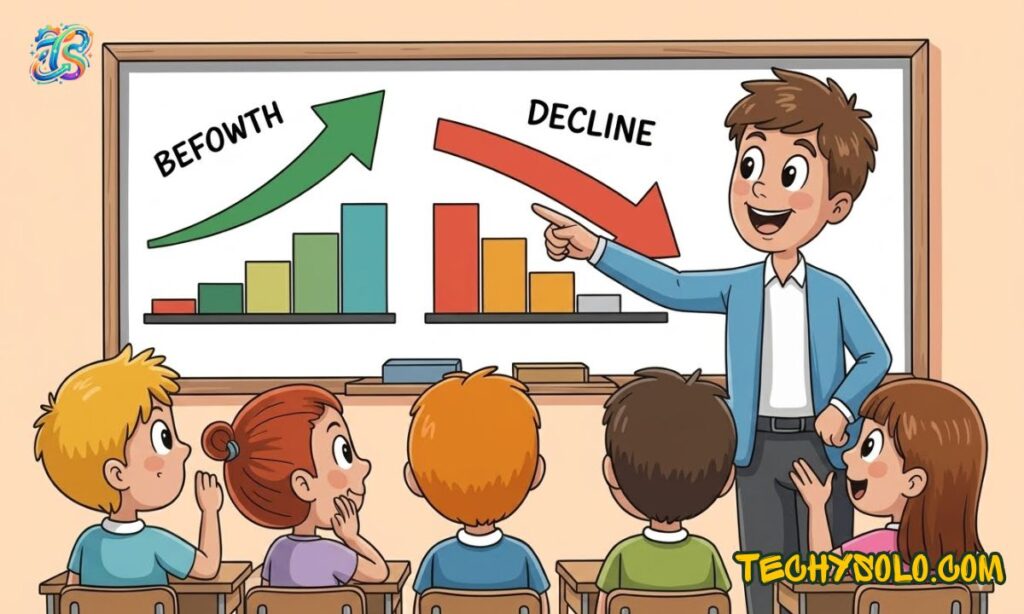
While no single word works in every situation, several antonyms commonly represent the opposite of growth.
39 Common Antonyms of Growth
- Decline
- Stagnation
- Regression
- Decay
- Atrophy
- Deterioration
- Shrinkage
- Reduction
- Decrease
- Contraction
- Collapse
- Loss
- Weakening
- Degeneration
- Recession
- Downturn
- Failure
- Setback
- Retreat
- Erosion
- Depletion
- Worsening
- Diminishment
- Impairment
- Limitation
- Crumbling
- Corrosion
- Breakdown
- Falling
- Declining
- Reversal
- Disintegration
- Exhaustion
- Weakness
- Reductionism
- Dwindling
- Attrition
- Declension
- Retrogression
Stagnation
Stagnation refers to a lack of progress or movement.
Meaning: Remaining unchanged over time.
Example:
- The business suffered years of stagnation.
Decline
Decline means moving downward in quality, value, or performance.
Example:
- Sales entered a steady decline.
Decay
Decay refers to gradual deterioration or breakdown.
Example:
- The abandoned building showed signs of decay.
Regression
Regression means returning to a less developed state.
Example:
- Economic regression affected the region.
Atrophy
Atrophy refers to weakening caused by inactivity.
Example:
- Muscle atrophy can occur after long periods of bed rest.
Deterioration
Deterioration means becoming worse over time.
Example:
- The patient’s condition showed signs of deterioration.
Examples
Stagnation Examples
- Career stagnation can reduce motivation.
- The economy experienced stagnation for years.
- Learning stagnation often results from lack of challenges.
Decline Examples
- Population decline affected local businesses.
- The company reported a decline in profits.
- Health decline became noticeable over time.
Decay Examples
- Tooth decay is preventable.
- The old structure showed severe decay.
- Environmental neglect led to decay.
Regression Examples
- The child showed regression in language skills.
- Economic regression slowed investment.
- Emotional regression can happen under stress.
Atrophy Examples
- Lack of exercise causes muscle atrophy.
- Skills may experience atrophy when unused.
- Brain function can suffer from cognitive atrophy.
Deterioration Examples
- Road deterioration increased repair costs.
- The relationship experienced gradual deterioration.
- Weather caused deterioration of the building.
Usage Rules
Choosing the right antonym depends on context.
| Context | Best Antonym |
| Business | Decline |
| Economics | Recession |
| Personal Development | Regression |
| Health | Deterioration |
| Physical Strength | Atrophy |
| Progress | Stagnation |
Quick Tip
Use the most precise antonym rather than automatically choosing “decline.”
Common Mistakes
Mistake 1: Using Decline for Every Situation
Not all forms of reduced growth are declines.
Example:
- Skill loss may be better described as atrophy.
- Lack of progress may be stagnation.
Mistake 2: Confusing Stagnation with Decline
Stagnation means no movement.
Decline means movement backward.
Mistake 3: Using Regression Incorrectly
Regression specifically refers to moving to a previous or less developed state.
Mistake 4: Ignoring Context
Economic decline and biological atrophy are not interchangeable.
Practice Exercises
Exercise 1: Fill in the Blanks
Choose the best antonym.
- Years of economic ______ affected employment.
- The athlete experienced muscle ______ after injury.
- The abandoned home showed signs of ______.
Answers:
- Decline
- Atrophy
- Decay
Exercise 2: Synonym or Antonym
Identify whether the word is a synonym or antonym of growth.
| Word | Answer |
| Expansion | Synonym |
| Regression | Antonym |
| Development | Synonym |
| Deterioration | Antonym |
| Progress | Synonym |
Exercise 3: Sentence Completion
Complete each sentence.
- Without innovation, organizations may face ______.
- Economic ______ reduced consumer confidence.
- Long-term neglect caused severe ______.
Answers:
- Stagnation
- Decline
- Deterioration
Advanced Topics
The absence of growth often results from multiple interacting factors.
Understanding these influences provides deeper insight into development and decline.
Factors That Influence Growth
Personal and Developmental Factors:
Personal habits often determine whether growth occurs.
Examples:
- Goal setting
- Self-discipline
- Learning habits
- Adaptability
Upbringing and Family Environment:
Family support significantly affects growth.
Positive environments often encourage:
- Confidence
- Education
- Skill development
Life Experience and Maturity:
Experience can accelerate growth.
Challenges often create opportunities for:
- Learning
- Resilience
- Perspective
Personality and Temperament:
Different personalities approach growth differently.
Traits that encourage growth:
- Curiosity
- Persistence
- Openness
Social and Environmental Influences
Cultural Norms and Expectations:
Culture shapes how growth is defined and rewarded.
Examples:
- Academic achievement
- Career advancement
- Personal independence
Peer Groups and Social Circles:
People often mirror the habits of those around them.
Supportive groups encourage:
- Improvement
- Motivation
- Accountability
Situational and Emotional Context
Immediate Circumstances:
Unexpected situations can affect growth.
Examples:
- Job loss
- Financial hardship
- Relocation
Mental and Emotional Health:
Mental well-being strongly influences growth potential.
Challenges may include:
- Anxiety
- Depression
- Burnout
- Chronic stress
Positive emotional health often promotes resilience and development.
Frequently Asked Questions
What is the opposite of growth in simple words?
The simplest opposite of growth is decline, meaning a decrease or reduction over time.
What word best describes the opposite of growth?
Decline is the most commonly used antonym, though stagnation and regression may fit specific contexts.
Is stagnation the opposite of growth?
Yes. Stagnation represents a lack of progress, making it a common opposite of growth.
What is the opposite of growth in economics?
In economics, recession, contraction, and decline are common opposites of growth.
Can decay be used as the opposite of growth?
Yes. Decay is often used when describing physical, biological, or structural deterioration.
What is the opposite of growth in personal development?
Regression is frequently used when personal development moves backward rather than forward.
Is decline stronger than stagnation?
Yes. Decline indicates deterioration, while stagnation simply means no progress.
What is the opposite of growth in biology?
Atrophy, degeneration, decay, and deterioration are commonly used biological opposites of growth.
Conclusion
Growth represents progress, development, improvement, and expansion, but many situations require understanding its opposite. Depending on context, the best antonym may be decline, stagnation, regression, decay, atrophy, or deterioration. Each word carries a slightly different meaning and should be chosen carefully based on the situation.
By understanding these distinctions, writers, students, professionals, and language learners can communicate more accurately and effectively. Whether discussing economics, biology, personal development, or business performance, selecting the correct opposite of growth adds precision and clarity to your writing.
Frequently Asked Questions
What is the most common opposite of growth?
Decline is generally considered the most common antonym of growth.
Are stagnation and decline the same?
No. Stagnation means no progress, while decline means negative movement.
Can regression mean the opposite of growth?
Yes. Regression refers to moving back to a less advanced state.
Which antonym works best in business?
Decline, downturn, and contraction are often used in business contexts.
Is atrophy the opposite of growth?
In biological and physical development contexts, yes.
Can one word replace all opposites of growth?
No. The best antonym depends on the specific context.
Why is understanding antonyms important?
Antonyms improve vocabulary, writing accuracy, and communication clarity.

Akash is a grammar expert at TechySolo, sharing simple, clear, and practical English tips to help learners improve writing and communication skills easily.