

English grammar can become confusing when plural forms and apostrophes enter the picture. One common mistake people make is writing “coachs” instead of “coaches.” While both spellings may look believable at first glance, only one is grammatically correct in standard English.
The confusion usually happens because words ending in “ch” follow special pluralization rules. Things become even more complicated when possessive forms like “coach’s” and “coaches’” are added. Many writers struggle to know where the apostrophe belongs and when to use it.
Understanding the difference between “coachs,” “coach’s,” “coaches,” and “coaches’” can improve your writing, emails, reports, sports articles, and academic work. This guide explains each form clearly with examples, grammar rules, quick tips, and real-life sentence usage.
The Basics Singular vs Plural in Coach Grammar
The word “coach” is a singular noun. It can refer to:
- A sports trainer
- A mentor
- A teacher
- A bus or large vehicle
When making the word plural, English grammar requires adding “-es” because “coach” ends in “ch.”
Correct plural:
- Coaches
Incorrect plural:
- Coachs
Examples:
- One coach attended the meeting.
- Several coaches attended the seminar.
According to standard grammar rules, nouns ending in “ch,” “sh,” “s,” “x,” or “z” usually add “-es” to become plural.
Coachs The Singular Possessive
“Coach’s” is the singular possessive form.
It shows that one coach owns, controls, or is connected to something.
Formula:
- coach + apostrophe + s = coach’s
Examples of Singular Possessive Coach
- The coach’s whistle was loud.
- I borrowed the coach’s clipboard.
- The coach’s strategy helped the team win.
In these examples, one coach possesses something.
Tips for Using Coach’s
Use “coach’s” when:
- One coach owns something
- One coach performs an action connected to possession
- Referring to a single individual coach
Quick tip:
If you can replace the phrase with “belonging to the coach,” use “coach’s.”
Coaches The Plural Form (No Apostrophe)
“Coaches” is the simple plural form of “coach.”
It means more than one coach.
Examples of Plural Form of Coach
- The coaches discussed training plans.
- Several coaches attended the conference.
- The basketball coaches organized the tournament.
Notice there is no apostrophe because nothing is being possessed.
Key Reminder
- Coaches = more than one coach
- No ownership involved
- No apostrophe needed
This is the form most people mean when writing about multiple trainers or instructors.
Coaches The Plural Possessive
“Coaches’” is the plural possessive form.
It refers to something owned by multiple coaches.
Formula:
- coaches + apostrophe = coaches’
Examples of Plural Possessive Coaches
- The coaches’ meeting lasted two hours.
- The coaches’ offices were renovated.
- We reviewed the coaches’ recommendations.
Here, multiple coaches share ownership or connection.
Sentence Tips
Use “coaches’” when:
- More than one coach owns something
- A group of coaches shares responsibility
- Possession involves multiple people
Side by Side Comparison Coachs or Coaches
| Word | Meaning | Correct? |
| Coachs | Incorrect plural spelling | No |
| Coach’s | Singular possessive | Yes |
| Coaches | Correct plural form | Yes |
| Coaches’ | Plural possessive | Yes |
This table helps clarify the grammar difference quickly.
Common Mistakes and How to Avoid Them
Many English learners and even native speakers confuse plural and possessive forms.
Mistakes to Avoid
| Incorrect | Correct |
| Coachs meeting | Coaches meeting |
| The coachs whistle | The coach’s whistle |
| The coaches office | The coaches’ office |
| Two coach’s attended | Two coaches attended |
Quick Tips
- Add “-es” for plural nouns ending in “ch”
- Use apostrophes only for possession
- Never use “coachs” as a plural noun
Grammar mistakes involving apostrophes are among the most common writing errors in English.
Real Life Usage in Sentences
Understanding real examples makes grammar easier to remember.
Singular Possessive Examples
- The coach’s instructions were clear.
- Everyone respected the coach’s decision.
- The coach’s notebook contained practice drills.
Plural Possessive Examples
- The coaches’ schedules conflicted.
- We visited the coaches’ training center.
- The coaches’ opinions differed.
Simple Plural Examples
- The coaches traveled together.
- Experienced coaches improve team performance.
- The football coaches prepared new tactics.
When to Use Coachs or Coaches
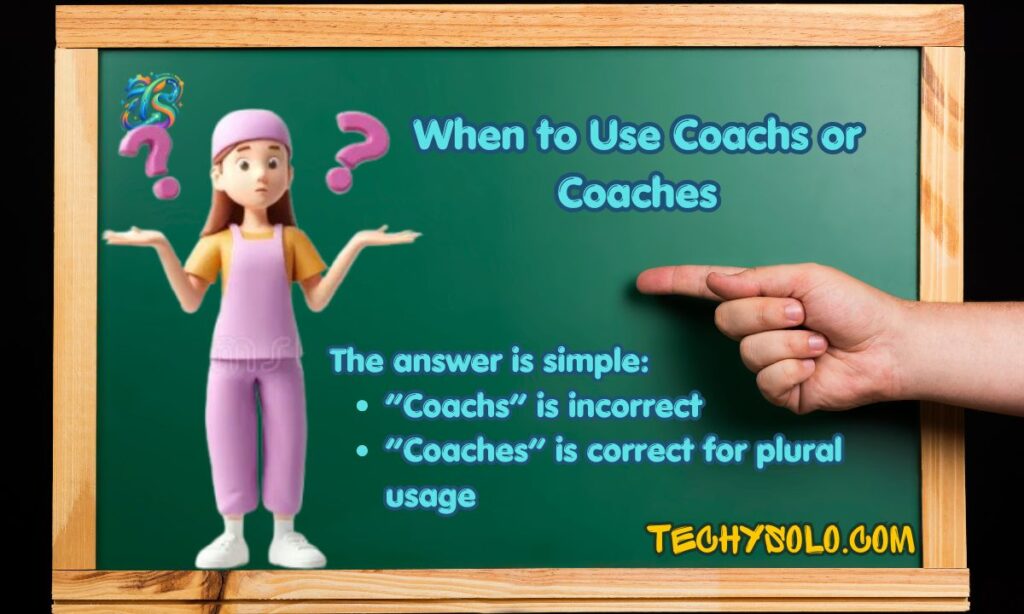
The answer is simple:
- “Coachs” is incorrect
- “Coaches” is correct for plural usage
However, context matters when deciding between:
- Coach’s
- Coaches
- Coaches’
Emails & Reports
Correct examples:
- The coach’s feedback was helpful.
- The coaches approved the proposal.
Professional communication requires correct apostrophe usage because grammar mistakes can reduce credibility.
Sports Articles
Sports writers frequently use these forms:
- The coaches discussed player injuries.
- The coach’s comments surprised fans.
- The coaches’ strategies shaped the championship.
Team Communication
Correct grammar improves clarity in:
- Team memos
- Training schedules
- Coaching reports
- Athlete evaluations
Quick Reference Cheat Sheet
| Situation | Correct Form |
| One coach | Coach |
| More than one coach | Coaches |
| Something owned by one coach | Coach’s |
| Something owned by many coaches | Coaches’ |
This quick guide helps avoid confusion during writing.
Coaching Tip Apostrophes in Action
Apostrophes do two jobs in English:
- Show possession
- Indicate contractions
In words like “coach’s” and “coaches’,” the apostrophe shows possession only.
Examples:
- Coach’s office = office belonging to one coach
- Coaches’ office = office belonging to several coaches
Understanding this rule improves both grammar and professional writing accuracy.
Fun Facts About Apostrophes in English
Apostrophes are one of the most misused punctuation marks in English.
Interesting facts:
- Apostrophe mistakes are common in signs and advertisements
- Many businesses accidentally create incorrect plurals
- English learners often confuse plural and possessive forms
Examples of common mistakes:
- Apple’s for sale
- Teacher’s lounge rules
- Dog’s welcome
Not every word ending with “s” needs an apostrophe.
Quick Examples in Sports
Sports writing frequently uses possessive grammar.
Examples:
- The coach’s game plan succeeded.
- The coaches celebrated the victory.
- The coaches’ locker room was crowded.
These examples show how apostrophes change meaning instantly.
Case Study Coaching Seminars
Imagine a coaching seminar with multiple instructors.
Correct sentences:
- The coaches presented leadership techniques.
- The coaches’ seminar attracted hundreds of athletes.
- One coach’s presentation focused on teamwork.
Each sentence uses a different grammatical structure correctly.
Reference Cambridge Dictionary Definitions
Cambridge Dictionary defines “coach” as a trainer, instructor, mentor, or large passenger vehicle. The correct plural form is “coaches,” while possessive forms depend on ownership context.
Conclusion
The difference between “coachs,” “coach’s,” “coaches,” and “coaches’” becomes much easier once you understand plural and possessive grammar rules.
Remember these simple points:
- “Coachs” is incorrect
- “Coaches” is the correct plural form
- “Coach’s” shows singular possession
- “Coaches’” shows plural possession
Using apostrophes correctly improves professionalism, readability, and grammar accuracy in emails, sports writing, reports, and academic content.
Whenever you feel unsure, ask yourself:
- Is it plural?
- Is it possessive?
- Is one coach involved or many?
That quick check will help you choose the correct form every time.
Frequently Asked Questions
Is “coachs” a correct word?
No. The correct plural form is “coaches.”
What is the plural of coach?
The plural form is “coaches.”
What does “coach’s” mean?
It shows possession by one coach.
What does “coaches’” mean?
It shows possession by multiple coaches.
Why does “coach” become “coaches”?
Words ending in “ch” usually add “-es” to form plurals.
Is “coaches” singular or plural?
“Coaches” is plural.

Akash is a grammar expert at TechySolo, sharing simple, clear, and practical English tips to help learners improve writing and communication skills easily.